
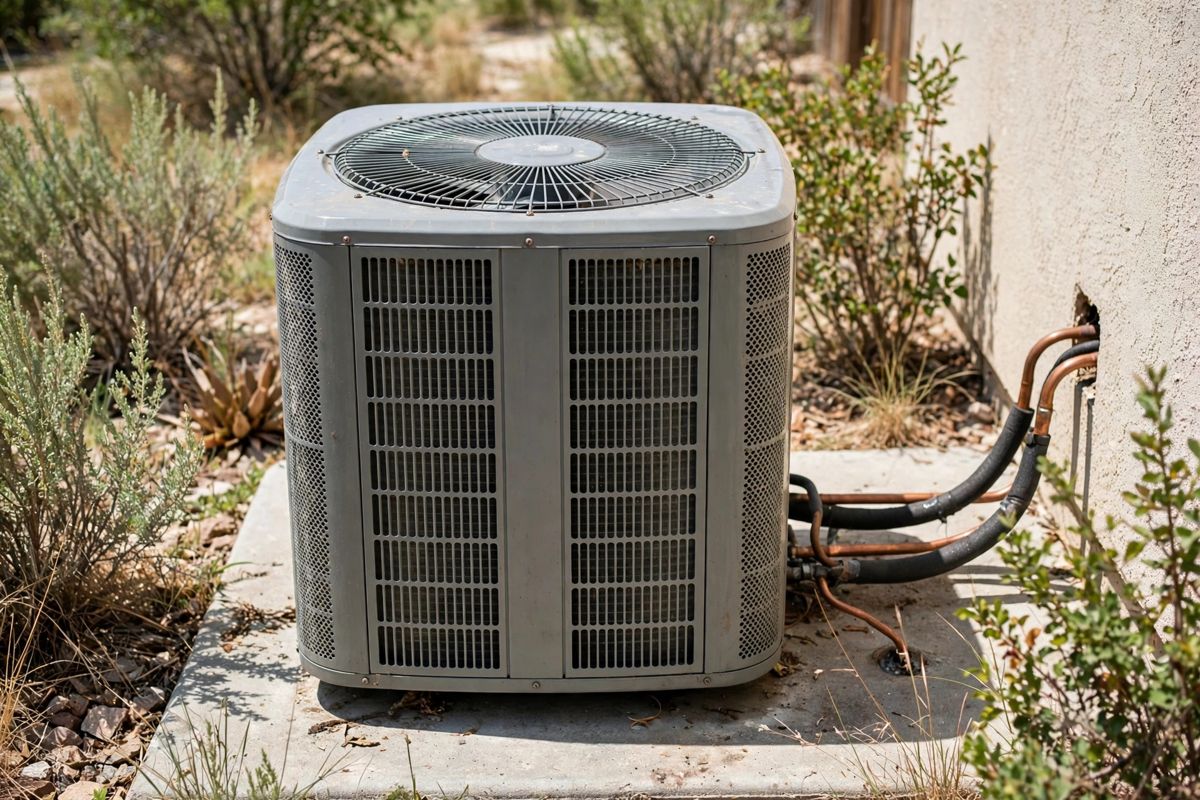
Why Texas years are not mild-climate years
A cooling system wears out by the hour, not by the calendar. Compressors, fan motors and capacitors age with every start and every hour of loaded running.
Cibolo's climate piles those hours on: roughly 3,148 cooling degree days a year, about 122 days at or above 90 degrees, and around 20 days past 100. The season effectively runs May through September.
Add it up and a local system commonly logs 2,000 or more running hours in a single year. A system in a mild climate may log half that, which is why the same equipment earns a longer quoted life there.
Ten to 15 years is therefore the honest local expectation. A Cibolo system at 12 has done the work of a 20-year-old system somewhere gentle.
My unit is 11 years old and still cooling. Is it on borrowed time?
It is in the second half of its expected local life, which calls for planning rather than worry. Keep it maintained, watch for warning signs, and price replacement in mild weather so a failure never forces a rushed decision.
Does brand change the 10-to-15-year expectation?
Less than installation and maintenance do. A well-installed, well-kept standard system routinely outlasts a neglected premium one in this climate. Sizing, duct condition and clean coils move the number more than the badge.
What the local housing stock tells us
About 74 percent of homes in ZIP 78108 were built between 2000 and 2019. Their builder-grade systems are now roughly 7 to 25 years old — a whole generation arriving at end of life together.
Homes built from 2010 to 2022 commonly hit their first major failure at 8 to 12 years. That first failure is usually a part, not a death sentence, but it opens the end-of-life conversation.
Subdivisions like Steele Creek, Turning Stone and Falcon Ridge share build eras, which is why whole streets seem to replace systems within a few summers of each other.
If your neighbours are replacing, that is information, not pressure. Their systems share your system's age, builder and summers — the three biggest lifespan factors you have.
What shortens a system's life here
Dirty coils shorten life quietly. A matted outdoor coil forces longer, hotter running on every cycle, and the compressor pays for it season after season.
Oversizing shortens life loudly. A too-big system starts and stops constantly, and starts are the hardest moments in a compressor's day. Short cycling also leaves humidity behind.
Neglected drains and filters do slower damage: iced coils, water overflow, starved airflow. Each one pushes the system to run longer for the same cooling.
Deferred small repairs belong on the list too. A weak capacitor left struggling makes every start harder on the compressor it serves. The full warning-signs guide shows what to watch for.
| Factor | Shortens life | Extends life |
|---|---|---|
| Running hours | Long seasons, low thermostat settings | Reasonable settings, good insulation |
| Coil condition | Matted, dirty outdoor coil | Annual cleaning and clear airflow |
| Sizing | Oversized, short cycling | Load-calculated, matched sizing |
| Maintenance | Skipped checks, clogged filters | Yearly tune-up, fresh filters |
| Small repairs | Weak parts left struggling | Early fixes in the $150–$650 band |
What extends life, realistically
An annual pre-summer check is the highest-value habit: capacitors tested before they fail, drains cleared, coils cleaned, refrigerant charge verified. The tune-up page details what that visit covers.
Filters are the homeowner's share of the work. A fresh filter on schedule protects airflow and the indoor coil, and costs almost nothing compared with the repairs neglect invites.
Shade and clearance around the outdoor unit help at the margins: trimmed planting, no stored items against the cabinet, and discharge air free to escape upward.
None of this makes a system immortal. It moves a system toward the top of the 10-to-15-year band instead of the bottom — which, at replacement prices, is real money.
Can maintenance add years, or just delay bills?
Both effects are real but bounded. Maintenance prevents the early, compounding failures — dirty coils, weak capacitors, iced coils — that shave years off. It cannot reverse compressor wear already accumulated across thousands of running hours.
Is it worth repairing a 14-year-old system?
For a small fault, sometimes, as a bridge to a planned replacement. For major work like a compressor at $1,200–$2,500, rarely. Run the age-and-cost rules before spending, because at 14 the system is past its expected local life.
End-of-life signs, in the order they appear
First come the small tells: longer run times, a degree or two lost on the hottest afternoons, a power bill creeping up without a rate change to explain it.
Then the repairs change character. Parts that lasted years start failing in sequence — a capacitor one summer, a contactor the next, a motor after that. The pattern matters more than any single bill.
Refrigerant trouble is a late sign with a price tag: repeat recharges, especially on an R-22 system at $90–$250 per pound, mean the sealed circuit is ageing out — the local repair ranges put that pattern in context.
The final signs are unmistakable: cooling that never catches up, new grinding or rattling sounds, and a major-part quote. The blog guide to signs your AC is about to fail walks through each warning in detail.
Planning the end instead of meeting it in July
The least costly replacement is the planned one. Pricing a new system in spring or autumn, inside the usual $5,000–$12,000-plus band, beats an emergency install during a heat wave every time.
Use the quiet months to run the decision properly. The repair versus replace guide gives you the 5,000 rule and percentage guides with local numbers already filled in.
Check your system's age now, from the data plate on the outdoor unit, and write it somewhere you will find it. Most homeowners facing a July failure do not know their system's age until a pro reads it.
BreezeCrew connects Cibolo homeowners with independent local pros for both the maintenance that extends life and the honest assessment when life is nearly spent. The replacement cost guide is the place to start the numbers.
Questions homeowners ask
How many hours a year does a Cibolo AC run?
Commonly 2,000 hours or more. The area records about 3,148 cooling degree days, roughly 122 days a year at or above 90 degrees and around 20 days at or above 100. That workload is roughly double a mild-climate system's annual hours, which is exactly why local lifespan expectations run 10 to 15 years instead of 15 to 20.
My system is 9 years old and needs a motor. Replace it?
Usually not on its own. The strict 5,000 rule flags it — nine times $700 is 6,300 — but the percentage guides point the other way, since a motor is roughly a tenth of a $5,000–$12,000-plus replacement. Motors are wear parts, not sealed-system failures, so most pros repair here and watch the pattern instead.
Does a tune-up really extend a system's life?
It protects the life the system has. Annual checks catch weak capacitors, clogged drains and dirty coils before they compound into compressor strain, which is where years are actually lost. Maintenance will not make a worn compressor young again, but neglected systems reliably die at the bottom of the 10-to-15-year band while maintained ones reach the top.
Why did my neighbour's identical system last longer?
Small differences compound: a shadier lot, cleaner coils, a slightly kinder thermostat setting, fewer occupants or better insulation. Two systems installed the same week can differ by several years of life. That is why age alone never decides replacement — condition, repair history and performance complete the picture a pro assesses in person.
How do I find out my system's age and remaining life?
The outdoor unit's data plate lists the manufacture date, and a pro can judge condition from coil state, amp draws and repair history. Call (830) 555-0147 and BreezeCrew will match you with an independent local pro for that assessment, with any repair range in writing before work starts.
Related pages
Need a Cibolo AC pro?
System past its tenth Texas summer and acting up? Call (830) 555-0147 — BreezeCrew connects you with an independent local pro for an honest read on how much life is left.
Call (830) 555-0147