
What the on-off loop feels like at home
You hear the outdoor unit kick on, feel a brief breath of cool air, then silence again within five or ten minutes. Rooms never quite reach the set temperature, humidity hangs in the air, and the house feels clammy even when the thermostat number looks close.
Short runs never dehumidify properly, because moisture removal needs sustained coil time. On a Cibolo afternoon, indoor air can feel sticky at temperatures that should feel comfortable.
Starting current is several times running current, and the compressor, contactor, and capacitor absorb that jolt every cycle. A loop left running through a Texas summer can consume a season's worth of starts in a few weeks.
Safe checks before you book the visit
First, time the cycles. Note how long the system runs and how long it rests, across half an hour. Runs under ten minutes, repeated steadily, confirm the pattern — and that timing note is useful to the pro who takes the call.
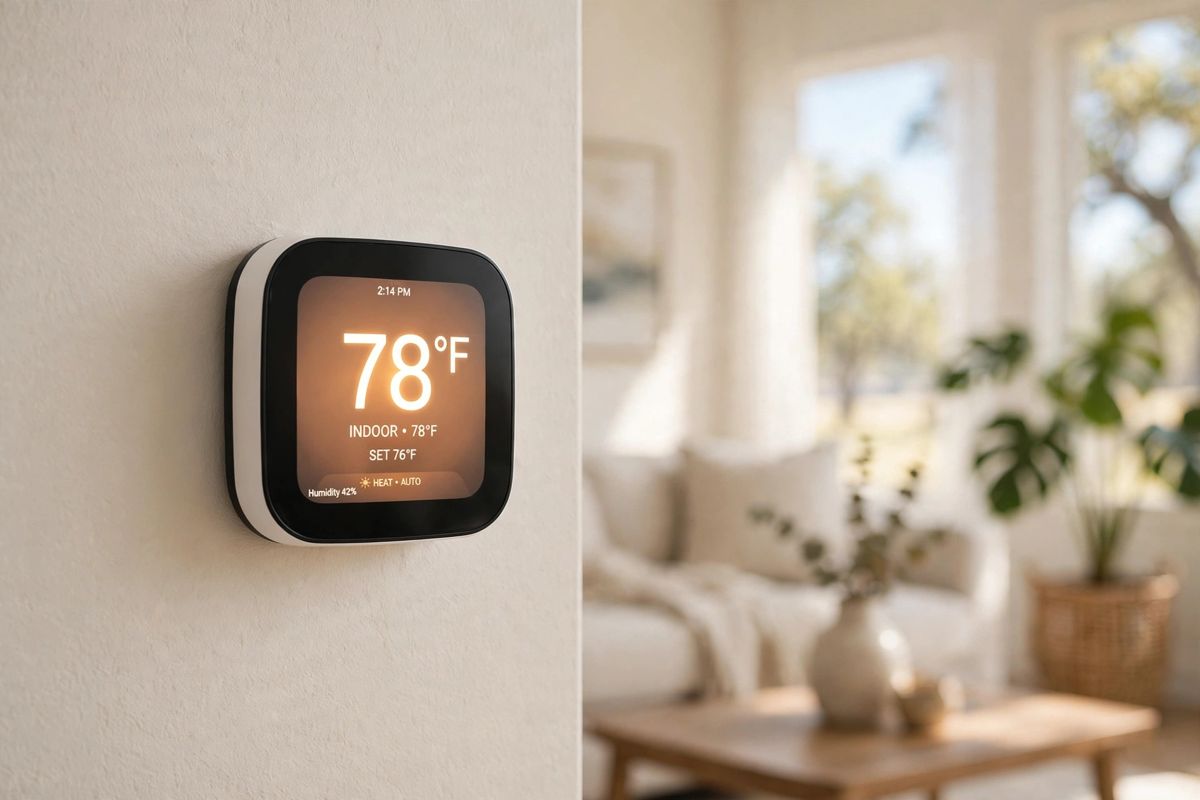
Second, check the thermostat's placement and settings. A thermostat hit by direct sun, a lamp, or supply air from a nearby vent can satisfy itself while the house stays warm. Confirm no heat source sits near it and that any cycle-rate or swing settings are at their defaults.
Third, replace a clogged filter. Severe airflow restriction can trip safety limits, which shut the system down mid-run. A filter you cannot see light through is a real suspect here, not a formality.
Fourth, look outside. A condenser buried in shrubs or fenced tight can overheat and trip its high-pressure protection on hot afternoons. Clear the space around it. If the breaker is involved, stop resetting it and read the emergency guidance on tripped breakers.
How short is too short for a cooling cycle?
On a hot afternoon, a healthy system runs long, steady cycles — often fifteen minutes or more. Repeated runs of five to ten minutes with brief rests, hour after hour, are the short-cycling pattern. Occasional short cycles in mild morning weather are normal.
Could my thermostat alone cause this?
Yes. A thermostat in a bad spot, a failing sensor, or aggressive cycle settings can start and stop a healthy system. That is why placement and settings are checked before anyone opens the outdoor unit.
The cause ladder, in checking order
After the thermostat and filter, the ladder climbs to airflow and safety limits. A failing blower or a very dirty coil can trip a limit switch mid-cycle, and a clogged drain with a float switch can cut the system off each time the pan fills.
Refrigerant faults sit mid-ladder. Low charge from a leak can drop pressures until a low-pressure switch stops the compressor; overcharge trips the high side instead. Either way, charge problems behind cycling need the leak checked properly, not a pressure tweak.
The top rungs are electrical and sizing. A weak capacitor or failing contactor can drop the compressor out mid-run, and an oversized system — rare, but real in fast-built subdivisions — cools the thermostat's corner so fast it never runs long. A system that also barely cools between cycles usually sits on the refrigerant or airflow rungs.
| Cause | Cycle clue | Typical fix |
|---|---|---|
| Thermostat placement or settings | Stops with rooms still warm | Relocate, reset, or replace thermostat |
| Clogged filter | Weak airflow, limit trips | New filter, airflow restored |
| Drain float switch tripping | Stops, restarts after pan drains | Drain cleared |
| Low refrigerant | Cooling weak between short runs | Leak repair plus recharge, $200–$600 |
| Weak capacitor or contactor | Compressor drops out mid-run | Part replaced, $150–$400 |
| Oversized system | Has cycled short since installation | Sizing review at replacement time |
What the pro measures to find the trigger
The visit starts with your timing notes, then moves to the safety chain: limit switches, pressure switches, and the float switch, tested to find which one is ending each cycle. That answer narrows the ladder to one or two rungs.
Airflow and refrigerant pressures come next, read while the system runs, alongside capacitor and contactor testing. A good pro watches several full cycles rather than one, because intermittent faults hide between cycles and show only under load.
Expect the finding in plain language with a written range before work starts. BreezeCrew connects Cibolo homeowners with independent local AC professionals, and the services hub shows the full scope a matched pro can cover.
Why does the pro need to watch it cycle?
Because the trigger is an event, not a state. Pressures, temperatures, and switch behaviour in the seconds before shutdown tell the story; a system sitting idle between cycles looks innocent. Watching two or three shutdowns separates a diagnosis from a guess.
Can short cycling be an electrical supply problem?
Occasionally. Voltage drops when the compressor starts can drop it out again, and a weak breaker can nuisance-trip. Those are found with a meter during starts, not by swapping parts. If supply is the cause, you will be told plainly.
What fixing the loop typically costs
The diagnostic visit commonly runs $75–$150 in this market, with some companies advertising lower dispatch fees that include less testing. Thermostat, filter, and drain causes often resolve inside the visit or the lower part of the common $150–$650 band.
Electrical rungs price as single parts: a capacitor at $150–$400 or a contactor at $150–$350, fitted. A blower motor behind airflow trips usually runs $300–$700.
Refrigerant rungs cost the leak-work price: a recharge as part of a completed leak repair at $200–$600, with coil work at $900–$2,500 as the rare ceiling. Compressor replacement at $1,200–$2,500 is what you are avoiding by fixing the loop early. The local cost guide sets out the full ladder.
When cycling becomes urgent
A cycling system still cools a little, so it rarely feels urgent on day one. It becomes urgent when cycles shorten further, when the breaker joins in, or when cooling collapses and indoor temperatures climb on a day pushing 100°F.
Treat burning smells, visible sparking, or a breaker that trips instantly as stop-now signs: switch the system off and do not restart it.
Otherwise, book promptly. Every week of looping burns compressor life that no repair can give back, and a fault diagnosed while the system still runs is almost always cheaper than the same fault after a hard failure in August.
Questions homeowners ask
Is short cycling really that damaging, or just annoying?
Damaging. A compressor draws its highest current and hardest stress in the first seconds of each start. Cycling six times an hour instead of once ages its compressor, capacitor, and contactor at several times the normal rate, while never dehumidifying properly.
My system has cycled short since it was installed. Is that different?
Yes — that pattern points at sizing rather than failure. An oversized system blasts the thermostat's area cold, shuts off, and restarts as warm air mixes back in. It has usually done it since day one. The honest fix is correct sizing at replacement time, with settings and airflow optimised meanwhile.
Can a dirty drain really switch the AC off and on?
It can, on systems with a float switch in the drain pan. Slime builds, the pan fills mid-cycle, the float cuts the system off, the pan drains, and the system restarts — a loop timed by water. The fix is a drain clear and flush.
Why does the house feel humid even when the temperature looks right?
Dehumidification needs run time. The coil has to stay cold long enough for moisture to condense and drain away. Five-minute cycles cool air near the thermostat without wringing moisture out of the house, so homes feel clammy at 75°F during a cycling fault.
Should I just set the thermostat much lower to force longer runs?
No. A lower set point does not change why a safety switch, pressure limit, or faulty part ends each cycle; it just makes the system attempt more starts against the same trigger. Time the cycles, work the safe checks, and let a measured diagnosis find the trigger.
Related pages
Need a Cibolo AC pro?
System starting and stopping every few minutes in your Cibolo home? Call (830) 555-0147 and BreezeCrew will match you with a local pro to find it.
Call (830) 555-0147