
What warm air from the vents actually means
Warm vent air means the indoor blower is doing its job while the cooling side is not. The indoor unit moves air, and the outdoor unit rejects heat. When only the first half works, you feel room-temperature or attic-warmed air at every register.
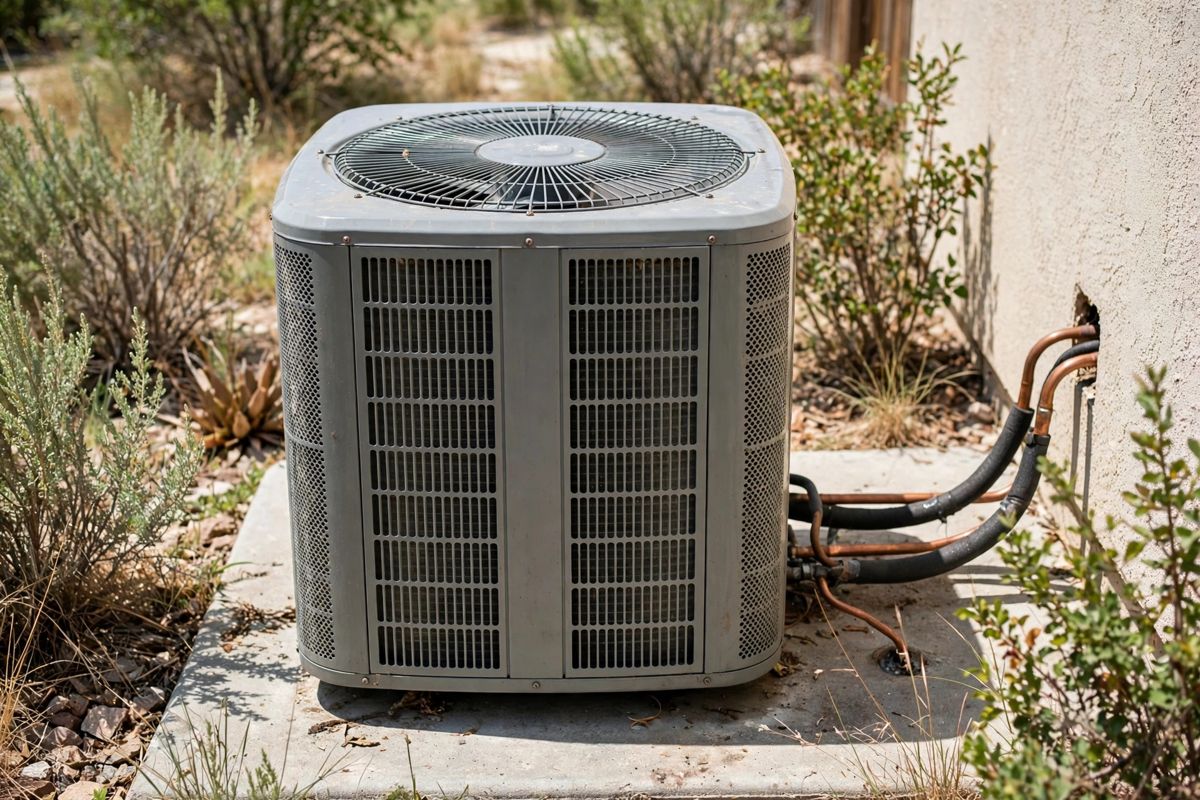
Put a hand at a supply vent, then step outside and look at the condenser. If the outdoor fan is still and silent while indoor air moves, the split between the halves is confirmed.
Do not keep the system running for hours hoping it recovers. A compressor trying to start against a failed part, or running with very low charge, takes real wear. Note what you observed, then work the check list below.
Safe checks, in the order that rules things out
First, the thermostat. Confirm cool mode, a set point below room temperature, and fresh batteries if it uses them. A thermostat set to fan-only or heat will move warm air all day without anything being broken.
Second, the breaker panel. Look for a tripped breaker for the outdoor unit and check the disconnect box near the condenser. If a breaker trips again right after resetting, stop — repeated tripping is a fault signal.
Third, the filter and the outdoor coil. A filter you cannot see light through chokes airflow badly enough to warm supply air. Outside, clear grass, leaves, and debris away from the condenser.
Fourth, listen at the outdoor unit. A humming unit that never starts points toward a capacitor or contactor. A running fan with a silent compressor points deeper. Either way, you have a useful report — and if the house is heating up fast, the emergency page explains when to treat it as urgent.
The outdoor fan spins but air is still warm. What does that suggest?
The fan and compressor are separate parts. A spinning fan with no cooling often means the compressor is not starting, the contactor is failing, or charge is very low. It points the visit toward electrical and refrigerant testing.
Can warm air fix itself overnight?
Occasionally a frozen coil thaws overnight and cooling returns briefly, but the cause remains. If warm air follows a freeze, airflow or charge still needs attention, and it usually returns on the next hot afternoon.
The cause ladder for warm vent air
The honest order starts cheap. Thermostat and power faults cost nothing to rule out. Next come the small electrical parts — capacitors and contactors — the classic midsummer failure in Cibolo's builder-grade housing stock, much of it now 7 to 25 years old.
Refrigerant sits a rung higher. Low charge warms the air gradually and often pairs with ice or hissing near the lines. Because charge only leaves through a leak, the durable fix is the leak repair itself, not a recharge alone.
The top rungs are the compressor and the indoor coil. When a compressor runs but cannot build pressure, or a coil is damaged, the bill climbs and replacement maths enters the conversation. A system that barely cools at all often sits one rung lower.
| Cause | What you notice | Typical outcome |
|---|---|---|
| Thermostat or power fault | Outdoor unit completely silent | Settings corrected or breaker fault found |
| Failed capacitor | Humming outside, fan will not start | Part replaced, $150–$400 |
| Failed contactor | Unit starts and stops erratically | Part replaced, $150–$350 |
| Low refrigerant | Cooling faded over weeks, possible ice | Leak repair plus recharge, $200–$600 |
| Dirty or blocked condenser coil | Long runs, hot air off the top of the unit | Coil cleaned |
| Compressor failure | Fan runs, no cooling, breaker may trip | Major repair, $1,200–$2,500 |
What the pro checks first, and why
The visit starts with the split you already observed: is the outdoor unit receiving power, is the contactor pulling in, and does the capacitor hold its rated charge? Those three tests take minutes and settle the most common warm-air faults.
Airflow and temperatures come next, then refrigerant pressures read against the day's outdoor temperature. A careful pro also inspects the indoor coil and filter rack, because a warm-air complaint sometimes hides an airflow problem behind an electrical one.
Expect a written range before any part is fitted. BreezeCrew connects Cibolo homeowners with independent local AC professionals, and the wider heating and cooling services are described on the services hub.
Why do capacitors fail so often in Texas heat?
Capacitors live in the outdoor unit, baking through summers with about 122 days at or above 90°F. Heat ages them faster than mild-climate use, and builder-grade parts in homes built in the 2000s and 2010s are now in that wear window.
Will a new capacitor fix warm air for good?
If the capacitor is the only fault, yes — it is a contained repair. A good visit still tests the compressor it serves, because a struggling compressor can take a fresh capacitor down with it.
What warm-air repairs typically cost
Start with the diagnostic: a full diagnostic visit commonly runs $75–$150 in this market, though some companies advertise lower dispatch fees. Ask what testing the fee covers.
Capacitors typically run $150–$400 and contactors $150–$350 fitted. Many warm-air calls close inside the common $150–$650 band, especially when the fault is a single electrical part caught early.
Higher rungs cost more. A recharge done as part of a proper leak repair usually runs $200–$600 for the job. Blower motor work falls around $300–$700, coil work $900–$2,500, and compressor work $1,200–$2,500. The local cost guide lays out the full ladder.
When warm air becomes a same-day problem
Warm air at noon in late July is not a wait-until-Monday fault. Indoor temperatures in a closed Cibolo home can climb into the 90s on a day when roughly 20 days a year pass 100°F outside, and that pace is hard on infants, older adults, and pets.
Treat it as urgent when the outdoor unit trips the breaker repeatedly, when you smell electrical burning, or when anyone at home cannot leave for a cooler place. Switch the system off at the thermostat rather than letting it strain.
If the house is merely uncomfortable and everyone can head to a cooler spot for a few hours, a prompt diagnostic the same day is still the right call. Warm-air faults rarely improve on their own.
Questions homeowners ask
Why is my AC blowing warm air all of a sudden?
Sudden warm air usually means a part stopped: a failed capacitor, a failed contactor, or a tripped breaker taking the outdoor unit offline while the indoor blower keeps running. Gradual warming over weeks points instead to low charge or dirty coils.
Can low refrigerant make air warm instead of just weak?
Yes. As charge falls, the indoor coil cannot absorb heat properly, supply air warms, and the coil may ice over. Because refrigerant only leaves through a leak, the lasting repair is finding and sealing that leak, then recharging. A recharge alone, at $200–$600, buys time but not a fix.
Is it safe to run the AC while it blows warm air?
For a short period while you work the checks, usually fine. Running it for hours is not: a compressor starting against a failed capacitor, or running with very low charge, wears quickly. If the breaker trips or you smell anything electrical, switch it off.
The outdoor unit is humming but the fan will not spin. What is that?
That is the classic capacitor symptom: power is reaching the unit, a motor is trying to start, and the part that gives it the starting push has failed. Do not reach into the unit or try to spin the fan by hand. Capacitor replacement typically runs $150–$400 once a pro confirms the fault.
How fast can warm air be fixed once diagnosed?
The common electrical faults are single-visit repairs when the part is on the truck, because capacitors and contactors are standard stock. Refrigerant and coil faults take longer. BreezeCrew matches you with a local pro through one call to (830) 555-0147.
Related pages
Need a Cibolo AC pro?
Vents pushing warm air in Cibolo heat? Call (830) 555-0147 and BreezeCrew will match you with a local pro to find which rung failed.
Call (830) 555-0147