
The signs your system is slowly losing charge
The fade is gradual. Cooling weakens a little each season, run times stretch, and the house holds temperature in May but loses ground by July. Supply air feels cool rather than cold, and humidity lingers because the coil never gets properly cold.
Sharper signs follow: ice on the refrigerant lines or the indoor coil, a faint hissing near a joint, or oily residue on copper fittings where escaping refrigerant carries compressor oil out with it. A system that needed gas last summer and needs it again now is telling you plainly that it leaks.
In Cibolo, where the cooling season runs roughly May through September with fringe weeks either side, a slow leak has months to drain a system each year. Homes across Steele Creek, Turning Stone, and Legendary Trails carry builder-grade line sets now 7 to 25 years old — prime age for joint and coil leaks.
Why refrigerant work is legally pro-only
Federal rules require EPA 608 certification to buy refrigerant and to open a charged system. That is not a sales line; it is the law, and it exists because refrigerant handling involves high pressures, chemical exposure, and environmental release rules.
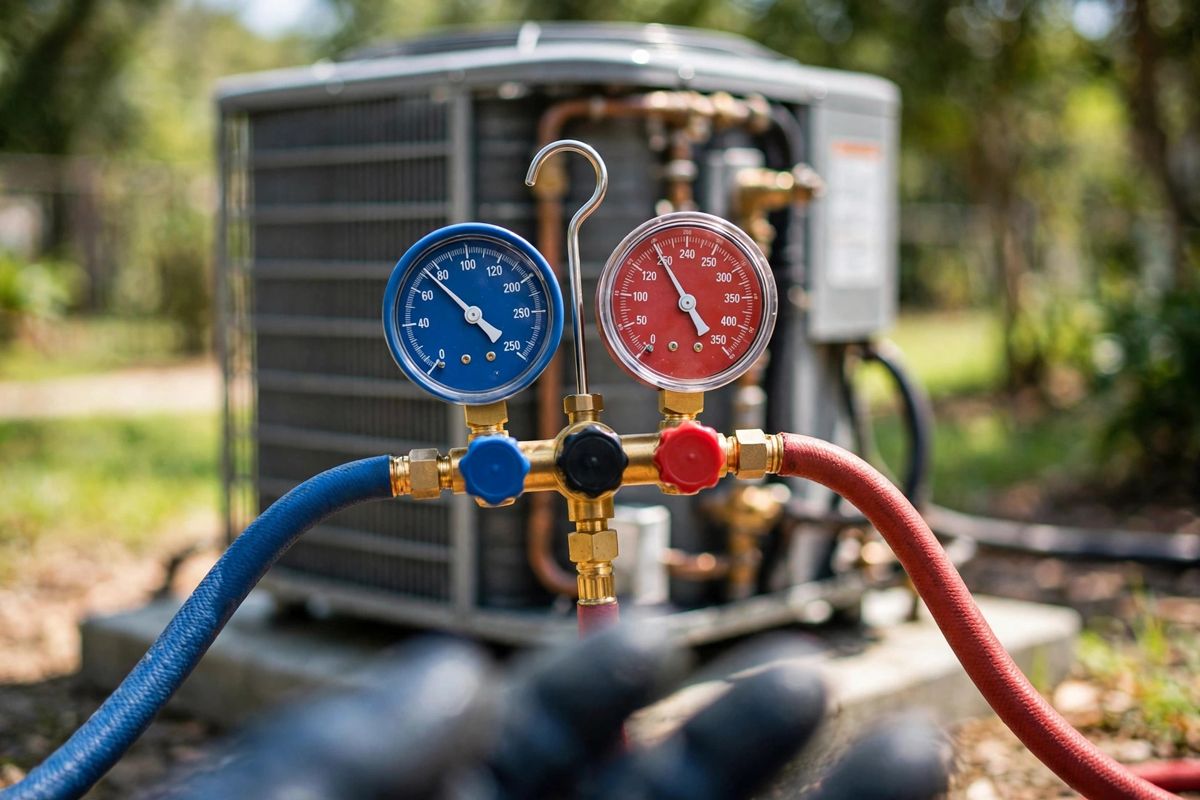
The certification point matters for your wallet too. A certified pro owns the gauges, vacuum pump, recovery equipment, and leak detectors the job needs, and is accountable for handling the refrigerant already in your system rather than venting it.
Newer systems add one more reason. Post-2024 equipment increasingly uses R-454B, a mildly flammable A2L refrigerant that demands specific handling and leak-sensor awareness. Guessing with modern refrigerants is not a homeowner project in any reading of the rules.
Can I buy a small can and top the system off myself?
No. Refrigerant sale and system charging are restricted to EPA 608 certified technicians, and charging without gauges, a vacuum, and a scale usually overcharges or undercharges the system. Both damage efficiency and can harm the compressor. The legal barrier lines up with the practical one here.
Is it illegal for a company to keep topping off a leaking system?
Repeated top-offs without leak work are poor practice and, for larger systems, run against EPA leak-repair expectations. For a homeowner system the practical point is simpler: every top-off without a seal is money spent renting cooling for a few weeks instead of owning the fix.
R-22, R-410A, and R-454B: why your refrigerant type matters
Older systems run R-22, phased out of production, which is why it costs $90–$250 per pound when it can be sourced at all. A leaking R-22 system forces a hard conversation, because expensive refrigerant into a leaking, ageing system rarely pencils out.
Most Cibolo systems from the last fifteen years run R-410A, still widely available and far cheaper per pound. For these, leak repair plus a weighed recharge is usually the sensible path, and the refrigerant itself is a modest share of the job cost.
Systems installed from 2025 onward ship with R-454B. It cannot be dropped into an R-410A system, and its A2L handling rules mean the matched pro needs the right sensors and procedures.
Tell the service your system age and refrigerant type from the outdoor unit's data plate when you call — it speeds up the match. More background sits in the R-454B explainer, and leak symptoms overlap heavily with systems that stop cooling.
How a proper leak repair actually runs
Step one is confirmation: pressure and temperature readings prove charge is low before anyone hunts. Step two is the hunt itself — electronic leak detectors swept along joints and coils, soap solution on suspect fittings, or ultraviolet dye circulated and inspected under a lamp.
Step three is the seal: a brazed joint repaired, a valve core replaced, a leaking coil section swapped, or in the worst case a coil replaced. Step four is evacuation, pulling the system into a deep vacuum to remove air and moisture that poison refrigerant circuits.
Only then comes the recharge, weighed in to the manufacturer's specification rather than guessed from pressure alone. The visit closes with cooling measurements at the vents.
If a quote skips steps two through four and jumps straight to adding gas, it is a top-off wearing a repair's clothes. The same discipline applies when a leak has already caused ice on the coil.
How long does leak detection take?
A joint or valve leak can show up within the first sweep of a detector. Coil leaks hidden inside fins or line sets buried in walls take longer, and dye methods need run time to circulate. Expect the hunt, not the seal, to be the slow part of the visit.
What if the leak is inside the indoor coil?
Coil leaks are the expensive case because the coil itself usually has to be replaced rather than patched. That is coil work at $900–$2,500, and on an older system it triggers a fair repair-versus-replace discussion. A written range and the system's age make that decision with numbers, not pressure.
What leak repair typically costs, honestly split
Budget in three parts. The diagnostic and leak search commonly begins with a visit at $75–$150. The seal itself prices by location: accessible joint and valve repairs usually keep the whole job inside or near the common $150–$650 band.
The recharge, once the system is sealed and evacuated, usually runs $200–$600 for the whole job on R-410A equipment, refrigerant included. R-22 changes the maths sharply at $90–$250 per pound, which is why older systems get a replacement conversation alongside the repair quote.
The ceiling case is the coil: $900–$2,500 for coil repair or replacement, against full system replacement at $5,000–$12,000 or more. One rule of thumb weighs age times repair cost against 5,000 and leans toward replacement past that line. The local cost guide and the services hub put these ranges in one place before you decide.
No top-off without a leak fix: what to insist on
Insist on three things in writing: where the leak is, how it will be sealed, and what the recharge will be weighed to. A company that cannot name the leak location has not found it, whatever the invoice calls the visit.
Ask what happens if charge drops again within the season. A sealed system holds its charge, so a fast repeat loss means the first hunt missed a second leak or the seal failed — that follow-up conversation should start from the first visit's paperwork.
There is one honest exception: a single small top-off to keep a heat-vulnerable household cool while a coil is on order. That is a bridge with a repair already scheduled, not a strategy. BreezeCrew connects Cibolo homeowners with independent local AC professionals who work the full sequence — found, fixed, sealed, then charged.
Questions homeowners ask
How do I know the leak is fixed and not just topped off?
Ask for the leak location, the repair method, and the vacuum and charge records from the visit. A real repair names a place — a joint, a valve, a coil — and the system is evacuated before recharging. Cooling is then measured at the vents. If the paperwork only lists pounds of refrigerant added, you bought a top-off, and the charge will drift low again over the following weeks or months.
How long should a proper recharge last?
Indefinitely, in a sealed system. Refrigerant does not wear out or get consumed; it circulates in a closed loop for the life of the equipment. A system that needs refrigerant every year, or every summer, has an unrepaired leak by definition. That is the core fact behind the no-top-off rule: charge loss is a leak symptom, never a maintenance item like a filter.
My system uses R-22. Is leak repair worth it?
It depends on the leak location and the system's age, and the numbers are steeper: R-22 runs $90–$250 per pound, so even a modest recharge after sealing can rival the cost of newer-system repairs. A cheap joint seal on a healthy compressor can still make sense. A coil leak on a fifteen-year-old R-22 system usually does not. Get the repair range and a replacement range side by side before deciding.
Can a leak damage other parts of the system?
Yes. Running low on charge makes the compressor run hotter and longer, because refrigerant also carries the oil that lubricates it and helps cool it. Chronic low charge is a quiet compressor killer, and compressor work runs $1,200–$2,500. Low charge also ices the coil, which can flood the drain pan when it thaws. Sealing a leak early protects the most expensive part in the system.
Will a leak make my power bills go up?
Noticeably, yes. A low system runs longer to do the same cooling, and in a climate with about 3,148 cooling degree days a year, longer run times add up across a five-month season. Many homeowners first suspect a leak from the bill rather than the vents: same thermostat habits, same weather pattern, higher consumption. Restoring correct charge after a seal brings run times, and bills, back toward normal.
Related pages
Need a Cibolo AC pro?
Cooling fading a little more every summer in Cibolo? Call (830) 555-0147 and BreezeCrew will match you with a local pro who finds and seals the leak before any recharge.
Call (830) 555-0147