
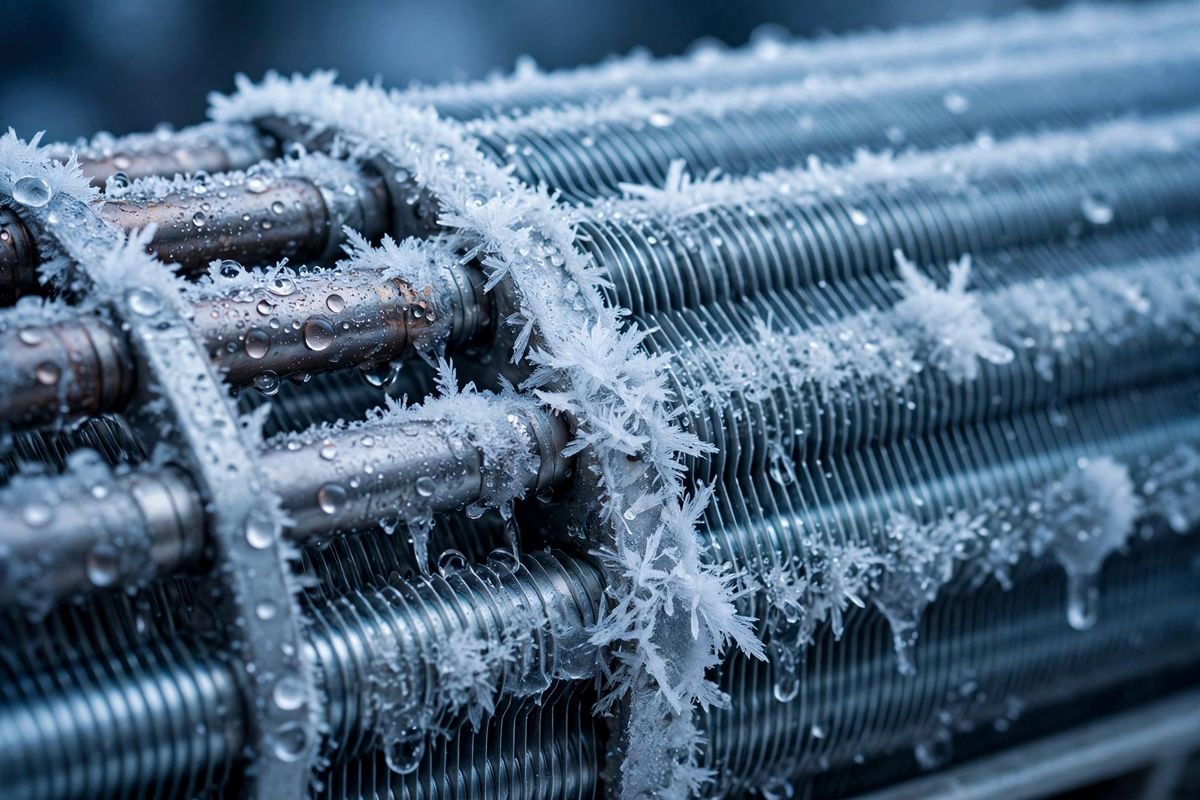
What a frozen system looks and sounds like
Start at the outdoor unit: frost or solid ice on the thick copper line, sometimes creeping onto the unit itself. Inside, the coil behind the air handler panel can carry a slab of ice.
The house gives earlier clues. Airflow at the vents weakens, supply air feels less cold, rooms turn humid, and run times stretch. Many Cibolo homeowners first notice a house that stops cooling properly in the afternoon, then spot the ice in the evening.
Ice blocks airflow across the coil, blocked airflow drops coil temperature further, and lower temperature grows more ice. Left running overnight, a system can freeze solid enough to stop airflow almost completely.
What to do first: shut it down safely
First, switch the thermostat from cool to off. Do not keep cycling it hoping the ice clears between runs. A frozen compressor works against conditions it was never built for, and that is how a fixable fault becomes a compressor bill.
Second, set the fan to on once the system is off, if your thermostat allows it. Room-temperature air across the coil thaws ice steadily over a few hours. Place towels near the indoor unit, because thawing releases the water the ice was holding.
Third, while it thaws, check the filter. A filter matted with dust is the most common airflow cause, and replacing it during the thaw is free diagnosis. Note whether vents were closed in unused rooms, too.
Fourth, do not chip ice off lines or coils, and do not restart cooling to test it. Restarting a half-thawed system refreezes it and hides the evidence. If meltwater starts leaking around the indoor unit, keep the system off and protect the floor.
How long does a frozen coil take to thaw?
Typically two to four hours with the fan running, longer for a solid freeze. The coil is ready when airflow feels full again and no water is still dripping into the pan.
Can I run just the fan overnight with a frozen system?
Fan-only running is the standard thaw method and is safe. What is not safe is cooling mode: the compressor must stay off until the ice is gone and the cause is understood, or the freeze returns within hours.
The cause ladder: airflow first, charge second
The ladder for ice has two main rails. Airflow causes include a clogged filter, a failing blower motor, a very dirty indoor coil, and closed or blocked vents. Any of them starve the coil of warm air, so its temperature falls below freezing and condensate turns to ice.
Charge causes sit on the other rail. When refrigerant leaks out, pressure in the coil drops, temperature drops with it, and ice forms even with healthy airflow. That is why a system that freezes every few weeks needs the leak found and sealed, not repeated thawing.
Builder-grade systems in Cibolo homes built in the 2000s and 2010s are now 7 to 25 years old, so both rails wear at once. A proper diagnosis tests airflow and charge together.
| Cause | Rail | How it is confirmed |
|---|---|---|
| Clogged filter | Airflow | Visual check, airflow improves with new filter |
| Failing blower motor | Airflow | Amp draw and airflow measurement, $300–$700 to replace |
| Dirty indoor coil | Airflow | Coil inspection behind the panel |
| Closed or blocked vents | Airflow | Room-by-room vent check |
| Low refrigerant from a leak | Charge | Pressure readings plus leak search, recharge job $200–$600 |
| Metering device fault | Charge | Pressure pattern across the coil |
What the pro does once the ice is gone
Timing matters: testing a frozen system gives nonsense readings, so the visit works properly after a full thaw. The pro measures airflow first, inspects the filter rack, blower, and coil face, and confirms the blower delivers what the system size demands.
Refrigerant testing follows, with pressures read against indoor and outdoor temperatures. If charge is low, leak detection begins — electronic sniffers, soap testing at joints, or dye — because refilling without sealing repeats the freeze.
You get the cause in plain language and a written range before work starts. BreezeCrew connects Cibolo homeowners with independent local AC professionals, and the full services list shows what one matched visit can cover.
Why can the pro not just test it while it is frozen?
Ice insulates the coil and blocks airflow, so readings describe the ice, not the system, and lead to wrong charge adjustments. A thawed system gives honest numbers, which is why pros ask you to shut it down hours before the visit.
Does one freeze damage the compressor permanently?
A single freeze caught early rarely does lasting harm. Repeated freezes are different: liquid refrigerant can reach the compressor and wear compounds. The pattern matters more than the event, which is why recurring ice needs a root-cause fix.
What fixing a freezing system typically costs
The diagnostic visit commonly runs $75–$150 in this market, and it has to cover both rails — airflow measurement and refrigerant testing — to be worth much. Some companies advertise lower dispatch fees, so ask what testing is included.
A coil cleaning or a capacitor at $150–$400 sits at the kind end; most simple freeze repairs land inside the common $150–$650 range. A blower motor replacement, the heavier airflow fix, usually runs $300–$700.
A recharge completed as part of a proper leak repair usually runs $200–$600 for the job, while coil replacement at $900–$2,500 is the uncommon top end when the leak lives inside the coil. Full figures are on the local repair cost page.
When ice turns into an urgent call
Ice alone, with the system safely off and thawing, is a prompt call rather than a panic. It turns urgent when the house heats up fast — Cibolo sees about 20 days a year at or above 100°F — and someone at home is very young, older, or unwell.
Call urgently if meltwater is dripping through a ceiling, if the breaker trips when the unit tries to run, or if this is the third freeze this summer. Recurring ice is how a $150–$650 repair becomes a $1,200–$2,500 compressor conversation.
If indoor temperatures are climbing into unsafe territory while you wait, the emergency guidance covers what to do. Otherwise, keep the system off, finish the thaw, and let the diagnosis happen on honest readings.
Questions homeowners ask
Why does ice form on an air conditioner in 100-degree heat?
The indoor coil normally runs cold but above freezing, and warm house air passing over it keeps it that way. Restrict that airflow, or drop the refrigerant charge, and coil temperature falls below freezing. Condensate then freezes on contact and builds layer by layer.
I changed the filter and the ice has not come back. Am I done?
Possibly — a choked filter is the most common cause, and if cooling, airflow, and run times returned to normal after a full thaw and a fresh filter, you may be done. Watch it for a week. If ice returns, the cause is deeper, most often low charge.
Can running the AC at a very low thermostat setting cause freezing?
It can contribute on cool nights, when low outdoor temperatures plus a low set point push coil temperature down. In peak summer it is rarely the sole cause. Still, a low target while airflow is weak stacks the odds toward ice.
What happens if I just keep running a frozen AC?
Cooling gets worse as ice insulates the coil, the compressor strains, and meltwater can overflow the drain pan. The expensive outcome is compressor damage: a part that runs $1,200–$2,500 to replace. Switching off early is the least costly decision.
How is a refrigerant leak behind freezing actually fixed?
After the thaw, the pro confirms low charge with pressure readings, then locates the leak with electronic detection or dye. The leak is sealed or the part replaced, the system is evacuated, and charge is weighed in to specification. Refrigerant handling requires EPA 608 certification by law, so this rung is professional-only work.
Related pages
Need a Cibolo AC pro?
Ice on the lines at your Cibolo home? Switch it off, let it thaw, then call (830) 555-0147 and BreezeCrew will match you with a local pro.
Call (830) 555-0147