
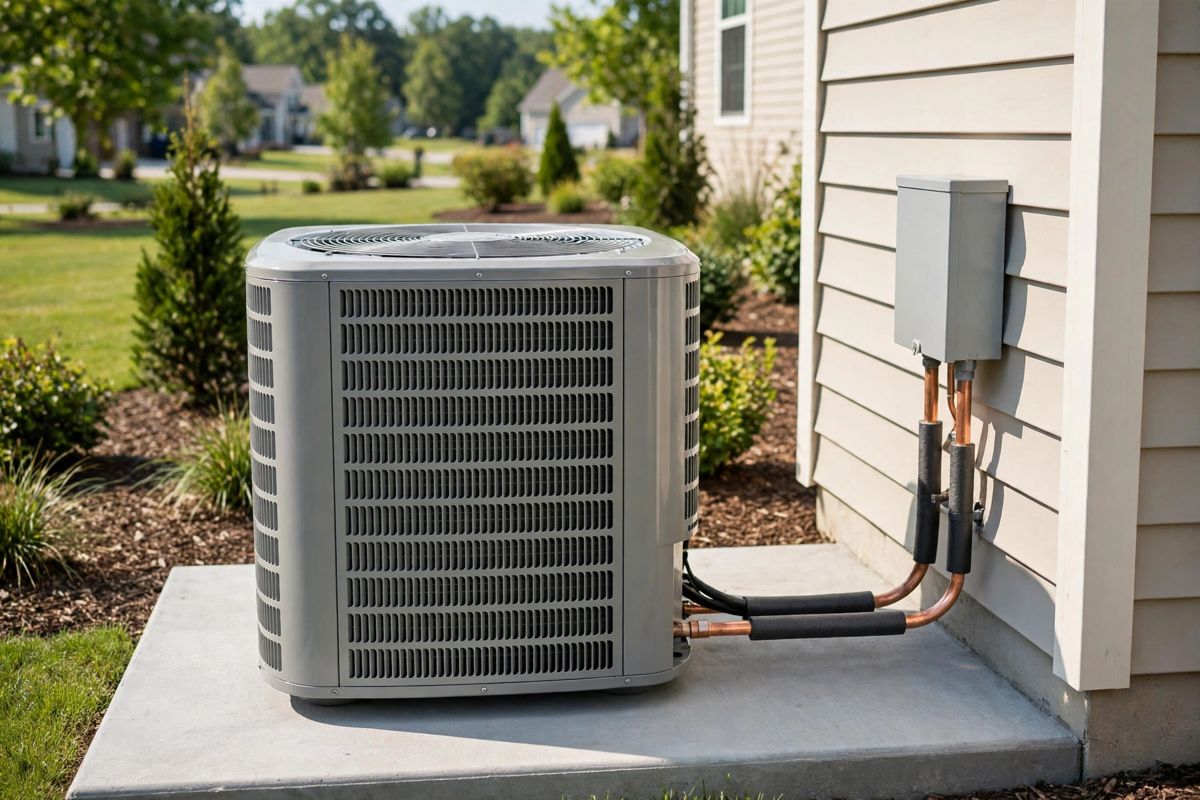
The honest headline range for a new system
For most Cibolo homes, a complete replacement — outdoor unit, indoor coil or air handler, and the labour to set it right — lands between $5,000 and $12,000 or more.
The low end is a smaller home, a standard-efficiency system, and ductwork that needs no changes. The high end is a larger two-story home, higher efficiency, and ducts or electrical work in the quote.
Anyone quoting a single fixed figure without seeing your home is guessing. Size, duct condition and refrigerant generation all have to be looked at before a real number exists.
This page also covers the new AC cost question directly: there is no separate cheaper category for an install in an existing home, because the same drivers set the price.
Does the range include the indoor unit?
A proper replacement quote should cover the matched system: outdoor condenser, indoor coil or air handler, and installation labour. Replacing only the outdoor box on an old indoor coil usually costs efficiency and warranty coverage.
Why do quotes say $12,000 or more?
Because the top end is open. Large homes, premium efficiency, new ductwork and electrical upgrades can each add to the bill, and a house needing several of them together moves past the typical band.
How size and efficiency frame the price
Think of the range as a ladder rather than a menu. Each step below moves a quote in a predictable direction, even though only an in-home assessment sets the final figure.
Two homes on the same street in Steele Creek or Turning Stone can sit at opposite ends of the ladder. Square footage, ceiling height, sun exposure and duct condition all differ behind identical front doors.
| Factor | Toward the $5,000 end | Toward the $12,000+ end |
|---|---|---|
| Home and system size | Smaller single-story, lower tonnage | Larger two-story, higher tonnage |
| Efficiency (SEER2) | Standard efficiency rating | High SEER2 rating |
| Ductwork | Existing ducts sound and sealed | Duct repair or replacement included |
| Heating side | Furnace kept or simple setup | New furnace or heat pump included |
| Install conditions | Easy access, pad and lines reused | Tight attic, new lines, electrical upgrades |
Tonnage: why the right size beats the biggest box
Tonnage is cooling capacity, and it should be matched to your home, not rounded up. An oversized system cools fast, shuts off early, and leaves Cibolo humidity hanging in the air.
An undersized system has the opposite problem: it runs all afternoon on a 100-degree day and never quite catches up, wearing itself out in the process.
Many Cibolo homes were built fast with builder-grade systems sized by rule of thumb. A replacement is the one chance to size the system from an actual load calculation.
If a quote jumps a full ton over your old system with no calculation behind it, ask why. Bigger costs more to buy and more to run.
A proper load calculation looks at square footage, window area and direction, insulation, ceiling height and duct runs. Two homes with identical floor plans can land on different sizes once sun exposure enters the maths.
Efficiency, ductwork and refrigerant: the other drivers
Efficiency is rated in SEER2, and each step up costs more upfront while using less power across roughly 3,148 cooling degree days a year. The SEER and SEER2 explainer shows where the payback stops making sense.
Ductwork is the silent driver. Leaky or undersized ducts waste the new system's output, and fixing them inside a replacement quote raises the price while genuinely improving the result.
Refrigerant generation matters now too. New systems ship with R-454B instead of R-410A, and the R-454B homeowner guide explains what that changes — and what it does not.
Electrical condition can add cost on older homes: a panel or disconnect that no longer meets code has to be corrected as part of a proper install.
Should I replace ductwork at the same time?
Only if it needs it. A pro should inspect and say what is wrong — leaks, crushed runs, undersized returns. Sound ducts should be sealed and kept, not sold back to you as new.
Is a heat pump priced differently?
A heat pump replacement sits in the same overall band for most homes, since it replaces both cooling and heating in one system. The overview of cooling and heating systems compares it against a standard split setup.
Why two quotes for the same house differ
Two quotes can differ by thousands and both be honest, because they may not describe the same job. One may include duct sealing, a new pad, a thermostat and permits; the other may not.
Efficiency is the other big gap. A standard-efficiency quote and a high-SEER2 quote for the same home are different products with different running costs for the next decade or more.
Warranty terms differ as well: parts coverage length, labour coverage, and whether the indoor and outdoor units are replaced as a matched set all change what you are really buying.
Compare line by line, not total by total. Ask each bidder what is excluded. The lowest total is often just the shortest list.
Quote detail is another difference. One bid may include flushing or replacing the refrigerant line set, hauling the old unit away and registering the warranty for you. Another may leave each of those as extras.
Validity windows differ as well. Equipment pricing moves, so one quote may hold for a month and another for a week. That does not change the install quality, but it changes how fast you must decide.
Before you sign: replacement or one more repair?
Replacement money is serious money, so test the decision first. If your current system is young and the repair is small, the local repair ranges may show a fix that buys years cheaply.
If the system is older and the repair quote is large, run the age-and-cost maths in the repair versus replace guide before committing either way.
Also weigh timing. Replacing in spring or autumn, before a failure forces your hand in July, usually means better availability and no emergency pressure on the decision.
When you are ready, the installation page explains how sizing and install day work. BreezeCrew connects you with an independent local pro for the assessment and the work.
Permits, warranty and the paperwork side
A proper replacement includes the unglamorous paperwork: permits where required, warranty registration, and documentation of the matched indoor and outdoor pairing. Skipping those steps is one way a quote gets artificially cheap.
Warranty registration matters more than most homeowners realise. Many manufacturers offer longer parts coverage when the system is registered promptly, and shorter standard coverage when nobody bothers.
Ask who registers the warranty, and get the confirmation in your hands before final payment. It is your coverage, on your equipment, and it should not live only in an installer's filing cabinet.
Keep the full quote paperwork with your home records. When a future repair or a home sale raises questions about the system's age and specification, that folder answers them in one page.
Questions homeowners ask
What is the average cost of a new AC system in Cibolo?
There is no single average worth trusting, because size and efficiency move the number so much. The honest frame is the full range: $5,000–$12,000 or more for a complete replacement in this area. A smaller home with standard efficiency sits near the low end, while larger homes with high efficiency and duct work sit near the top.
Does a bigger system always cost more to run?
An oversized system usually does. It short-cycles, cools unevenly and removes less humidity, so it runs again sooner. Correct sizing from a load calculation gives steadier comfort and lower bills than simply buying the largest unit. Ask any bidder to show the sizing maths behind the tonnage in their quote.
Should I pay more for a higher SEER2 rating?
Up to a point. In a climate with about 3,148 cooling degree days, moving from the minimum rating to a mid-range rating usually pays back over the system's life. The highest ratings cost much more for smaller extra savings. Compare the price jump against realistic bill savings, not against best-case marketing figures.
Why does ductwork change the replacement price?
Because the new system can only deliver what the ducts carry. Leaky, crushed or undersized ducts waste cooling and force the system to run longer. If a quote includes duct repair or replacement, it should say exactly which runs and why. Sound ductwork should be sealed and reused, which keeps the quote lower.
How do I get a replacement range for my home?
Call (830) 555-0147 and describe your home, current system size and age. BreezeCrew connects Cibolo homeowners with independent local pros who assess sizing, ducts and efficiency options in person. The range for your home should be in writing, line by line, before you are asked to commit to anything.
Related pages
Need a Cibolo AC pro?
Want a written replacement range for your actual home, not a guess? Call (830) 555-0147 — BreezeCrew matches you with an independent local pro who sizes the system before quoting it.
Call (830) 555-0147