
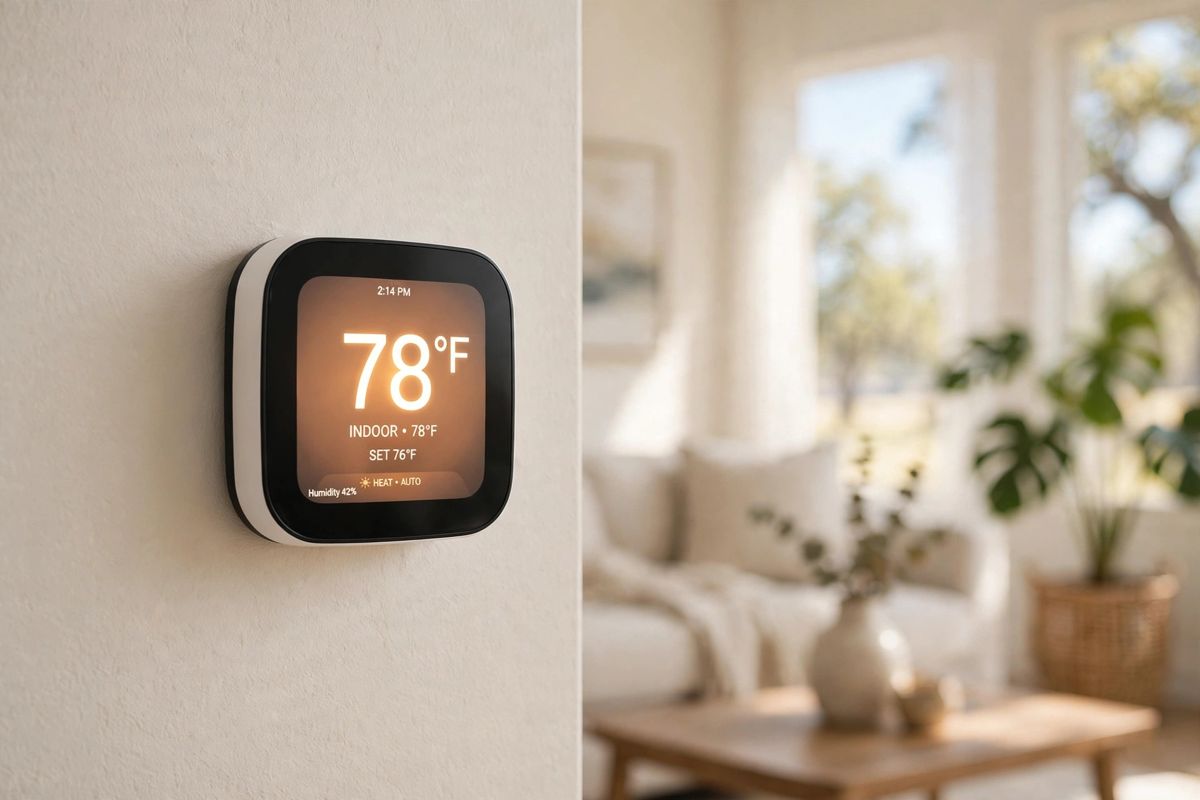
What it feels like when cooling quietly fades
The thermostat holds a number the house never reaches. Rooms feel close and damp, the system runs for long stretches without cycling off, and by late afternoon indoor temperature has drifted two or three degrees the wrong way.
In Cibolo subdivisions like Steele Creek, Turning Stone, and Falcon Ridge, most homes were built between 2000 and 2019. Their builder-grade systems are now roughly 7 to 25 years old — exactly the age when cooling fades gradually instead of failing at once.
A slow fade is rarely one dramatic break. It is usually a small restriction, a weak part, or a slow leak adding up over weeks.
Safe checks you can do before you call anyone
First, check the thermostat. Confirm it is set to cool, the set point is below room temperature, and the fan is on auto. Replace tired batteries if the display looks faint.
Second, look at the filter. Pull it out and hold it to the light. If you cannot see light through it, replace it. A clogged filter starves airflow, which alone can leave a house warm even when the equipment is sound.
Third, walk the vents and the outdoor unit. Open supply vents closed for winter, move furniture blocking returns, and clear leaves or grass from around the condenser.
Fourth, check the breaker and condensate area. A tripped breaker can stop the outdoor unit while indoor air still moves. If water sits near the indoor unit, stop and read about water leaking from the indoor unit before running the system further.
How long should I wait after changing the filter?
Give the house two to three hours of steady running. If supply air feels cooler and temperatures start falling, airflow was a big part of the problem. If nothing changes, the cause sits deeper and needs testing.
Is lukewarm air at one vent a whole-system problem?
Not always. One warm vent can point to a disconnected or crushed duct run to that room. Warm air at every vent points back to the equipment, which is why noting the pattern helps the pro you are matched with.
The cause ladder, from simple to serious
Think of the causes as a ladder. The bottom rungs are airflow and maintenance items a homeowner can influence. The middle rungs are electrical parts and refrigerant charge. The top rungs are coils and the compressor, where repair-versus-replace thinking starts.
Dirty coils sit in the middle and fool many people. A matted outdoor coil cannot shed heat, so the system runs longer and cools less. Indoor coil dirt does the same damage from the other side.
Low refrigerant is never just a top-up question. Charge only drops when there is a leak, so a system that cools poorly every summer needs leak work, not another recharge. See the refrigerant leak page.
| Cause | Typical clue | Usual fix |
|---|---|---|
| Clogged filter or blocked vents | Weak airflow at every vent | New filter, vents opened |
| Dirty outdoor coil | Long run times, warm discharge air | Coil cleaning |
| Weak capacitor or contactor | Outdoor unit hums or starts hard | Part replacement |
| Low refrigerant from a leak | Cools less each season, ice possible | Leak repair, then recharge |
| Failing blower motor | Barely any air movement | Motor replacement |
| Worn compressor | Runs but barely cools at all | Major repair or replacement talk |
What the pro does during the visit
A local pro handles the visit in a set order. Temperatures are measured at the return and supply to confirm how much cooling is happening. Static pressure and airflow come next, because guessing without airflow numbers wastes time.
Electrical testing follows: capacitor values, contactor condition, amp draws on the compressor and fan motors. Refrigerant pressures are checked against outdoor temperature, and coil condition is inspected rather than assumed from age.
You should get findings in plain language and a written price range before work starts. BreezeCrew connects Cibolo homeowners with independent local AC professionals, so the decision stays with you and the pro you are matched with.
Should a pro ever just add refrigerant and leave?
Only as a short diagnostic step in rare cases. Charge leaves through a leak, so adding refrigerant without finding the leak buys a few weeks at most. A proper visit explains where the charge went and what sealing it involves.
What should I tell the pro before the visit?
Note when cooling faded, whether airflow changed, any ice or water you saw, and the system age if you know it. Mention recent filter changes too. That history helps the first visit count.
What weak cooling typically costs to fix
Costs follow the ladder. A full diagnostic visit commonly runs $75–$150, and some companies advertise lower dispatch fees, so ask what the visit includes. Many cooling-fade repairs land in the common $150–$650 band once the cause is found.
A capacitor typically runs $150–$400 and a contactor $150–$350, parts and labour combined. A blower motor replacement usually falls in the $300–$700 range, depending on motor type and access.
Refrigerant work costs more because finding the leak is the real job. A recharge as part of a completed leak repair usually runs $200–$600 for the whole job.
Coil work at $900–$2,500 and compressor work at $1,200–$2,500 are the top-rung numbers. The full breakdown sits on the local repair cost page, alongside the wider heating and cooling services this service covers.
When weak cooling stops being a wait-and-see problem
Call sooner when the house cannot get below the mid-80s indoors, when ice appears on the refrigerant lines, or when the breaker trips repeatedly. Those signs mean the system is straining, and running it hard can damage the compressor.
Heat changes the maths in Cibolo. The area sees about 122 days a year at or above 90°F and roughly 20 days at or above 100°F. A weak system in June rarely heals itself before August, and indoor heat builds fast for young kids, older adults, and pets.
If someone at home is heat-sensitive and temperatures keep climbing, treat it as urgent and use the emergency help page. Otherwise, book the diagnostic while the system still cools a little. A yearly pre-summer tune-up is how most of these fades get caught early.
Questions homeowners ask
Why does my house cool at night but not in the afternoon?
Afternoon is peak load: full sun, hot attic air, and the highest outdoor temperatures. A system with dirty coils, low charge, or weak airflow can hold the line at 9am and lose it by 4pm. That points to capacity loss, not a thermostat fault, and is worth a diagnostic before the hotter weeks arrive.
Can a dirty filter really stop a house from cooling?
Yes. The system moves heat by moving air, and a clogged filter chokes that air. Cooling drops, run times stretch, humidity lingers, and the indoor coil can ice over. Changing a clogged filter sometimes restores cooling the same day.
My system is only eight years old. Why is it struggling already?
Many Cibolo homes built in the 2010s are hitting first major failures at 8 to 12 years. Builder-grade capacitors, contactors, and drain lines often wear out in that window, especially through long Texas summers. Most first failures are single parts in the $150–$650 range once diagnosed.
Should I set the thermostat lower to force colder air?
No. The thermostat is a switch, not a throttle. Setting 65°F instead of 72°F does not make supply air colder; it just runs the system nonstop, raises the power bill, and can ice a coil that already has airflow trouble. Set a normal target, work the safe checks, and let testing find the real limit.
When does weak cooling mean replacement instead of repair?
The conversation usually starts when a top-rung part fails on an older system: compressor work at $1,200–$2,500 or coil work at $900–$2,500 on a unit past its prime. One rule of thumb multiplies system age by repair cost, and leans toward replacement when the product passes 5,000.
Related pages
Need a Cibolo AC pro?
House running warm and not catching up? Call (830) 555-0147 and BreezeCrew will match you with a local pro who can work the cause ladder in person.
Call (830) 555-0147