
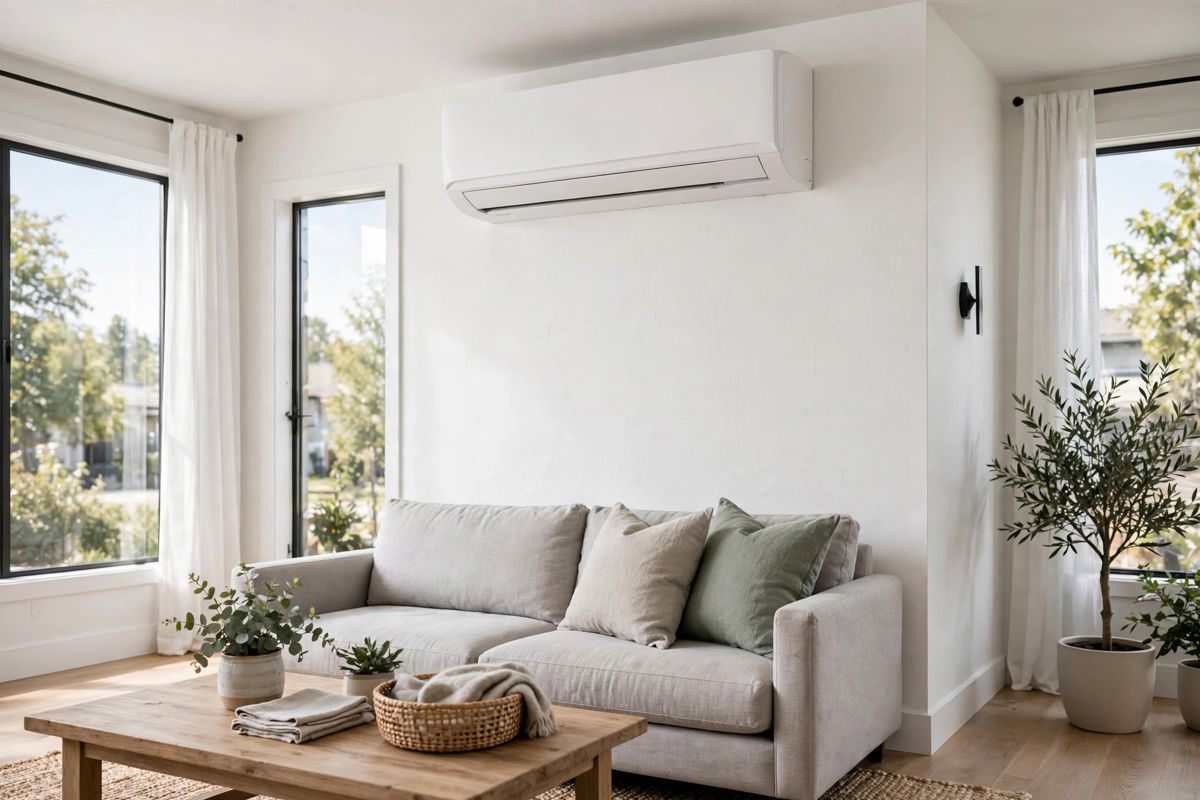
Central split air conditioning: the Cibolo standard
A split system divides the work: an outdoor condenser, an indoor coil and air handler, and ducts carrying cooled air to every room. It is what most local builders installed.
About 74 percent of homes in ZIP 78108 were built between 2000 and 2019, and the standard fit-out was a split system, usually paired with a gas furnace or an electric air handler.
Strengths are familiarity and whole-home coverage: every pro stocks its parts, and a single system handles the entire floor plan through existing ducts.
Limits show up in two-story homes, where one system serves two very different heat loads. The upstairs-downstairs gap is a duct and balance problem as much as an equipment one.
How do I know if my home has a split system?
Look for an outdoor condenser unit plus an indoor air handler or furnace with a coil, connected to ducts and vents in every room. If both halves exist, you have the standard split setup.
What usually fails first on a split system?
In Cibolo's 2000s and 2010s housing stock, capacitors, contactors and drain lines are the early failures, often at 8 to 12 years. Compressors and coils are the later, larger failures near end of life.
Heat pumps: one system for both seasons
A heat pump is an air conditioner that can run in reverse. In summer it moves heat out of the house; in winter it pulls heat from outdoor air and moves it inside.
Cibolo's climate suits it: only about 14 nights a year drop to freezing or below, and heating demand is roughly 1,438 degree days against 3,148 for cooling. Mild winters are heat pump territory.
The trade-off is feel and extremes. Heat pump air feels less hot at the vent than furnace air, and output dips during a hard freeze like the February 2021 event.
Many local heat pumps carry electric backup heat for those cold snaps. If yours struggles only in winter, the heat pump help page covers the usual faults.
| System type | How it cools | Best fit in Cibolo |
|---|---|---|
| Central split system | Outdoor condenser plus indoor coil and ducts | Most subdivision homes with existing ducts |
| Packaged unit | All components in one outdoor cabinet | Homes with no indoor space for an air handler |
| Heat pump | Reversible system, cools and heats | All-electric homes, mild-winter efficiency |
| Ductless mini-split | Outdoor unit feeding wall units, no ducts | Additions, garages, single problem rooms |
| Furnace pairing | Furnace heats, separate AC cools | Homes with gas service wanting strong heat |
Packaged units and ductless mini-splits
A packaged unit puts everything in one outdoor cabinet, usually at ground level or on a roof, with ducts running straight into the house. Nothing sits in the attic or a closet.
Packaged systems suit homes with no good indoor space for an air handler. The downside is exposure: the whole system lives outdoors in Texas heat and hail, and capacity options are narrower.
Ductless mini-splits take the opposite approach: small wall-mounted indoor heads, each serving one space, with no ducts at all. They shine in additions, converted garages and stubborn hot rooms.
Mini-splits cost more per room than a central system serving the whole house, so they solve specific problems rather than replacing whole-home cooling. Faults and care differ too — see the ductless service page.
Can a mini-split cool a whole house?
Technically yes, with multiple heads, but the cost usually beats a central system for a whole-home job. Mini-splits earn their money in spaces ducts cannot reach well, or where zoning one room matters most.
Are packaged units less efficient?
They can be, because every component sits outdoors and duct runs are short but exposed. For the right house they are still the practical choice. Efficiency ratings in SEER2 let you compare fairly across types.
Furnaces: the heating half of most local homes
Where a split system handles cooling, a furnace often handles heating. Gas furnaces are common in Cibolo subdivisions with gas service; electric air handlers cover many of the rest.
Heating demand here is short but real. A system that coasts through summer can still fail a family during a cold snap, which is when furnace help gets busy.
Furnaces generally outlast the cooling side, because they run far fewer hours in this climate. It is normal to replace a condenser and coil while keeping a sound furnace.
The pairing matters, though: the indoor coil and blower must match the outdoor unit's capacity, or the new cooling system never delivers its rated efficiency.
What Cibolo housing stock actually has
Drive Steele Creek, Turning Stone, Falcon Ridge or Legendary Trails and the pattern repeats: a single split system per home, builder-grade equipment, and ducts run through a hot attic.
Those builder systems are now roughly 7 to 25 years old. Homes built from 2010 to 2022 commonly hit their first major cooling failure at 8 to 12 years, whatever the badge on the unit.
Older and larger properties differ. Acre-plus homes toward Garden Ridge more often show packaged units, multiple systems for separate wings, or a mini-split added for a workshop or guest space.
Scenic Hills and other established areas add another wrinkle: mixed ages, where a newer condenser feeds older indoor equipment. Mismatched pairs are a common hidden cause of weak cooling.
Choosing a type when replacement time comes
Most Cibolo replacements stay with the type already fitted, because ducts, gas lines and electrical are built around it. Staying put keeps a replacement inside the usual $5,000–$12,000-plus band.
Switching types makes sense in specific cases: adding a mini-split for a room that never cools, or moving to a heat pump when a furnace and condenser both reach end of life together.
Efficiency comparisons should use SEER2 across all types, and the efficiency guide explains how much rating differences are worth on a Cibolo power bill.
Whatever the type, replacement pricing follows the same drivers. The replacement range guide lays them out, and BreezeCrew can match you with a pro who services your specific system.
Questions homeowners ask
What type of system do most Cibolo homes have?
A central split system: outdoor condenser, indoor coil and air handler or furnace, and ductwork throughout. Roughly three quarters of local homes were built between 2000 and 2019, when that was the standard builder fit-out. Heat pumps appear in all-electric homes, packaged units where indoor space is tight, and mini-splits mainly in additions and single problem rooms.
Is a heat pump a good choice in Cibolo?
Usually yes. Cooling dominates local demand at about 3,148 cooling degree days versus 1,438 heating, and only around 14 nights a year reach freezing. A heat pump handles both seasons efficiently in that climate. Expect cooler-feeling vent air in heating mode and reduced output during rare hard freezes, when backup heat takes over.
Can I switch from a split system to ductless?
You can, but whole-house ductless usually costs more than replacing the split system you already have ducts for. The stronger case is targeted: a mini-split for an addition, garage conversion or one room that never cools properly. A pro can compare both routes in writing so the comfort gain is weighed against the real price difference.
How long does each system type last here?
In Texas heat, plan on roughly 10 to 15 years for the cooling side of any type, shorter than mild-climate expectations. Furnaces often run longer because heating hours are few. Mini-split and heat pump lifespans follow the same hot-climate logic, since their compressors do the same long summer work. Maintenance and duct condition move any individual system within that span.
Who can tell me which type my home has?
Call (830) 555-0147 and describe what you see: outdoor unit, indoor closet or attic equipment, vents or wall units. BreezeCrew connects Cibolo homeowners with independent local pros matched to the system type, so the first visit starts with the right parts, manuals and expectations for your setup.
Related pages
Need a Cibolo AC pro?
Not sure which system your home runs, or planning a switch? Call (830) 555-0147 — BreezeCrew matches you with an independent local pro who works on your system type.
Call (830) 555-0147