
What a leak around the indoor unit feels like
It often starts small: a damp patch of carpet by the air handler closet, a faint drip after the system shuts off, or a water spot blooming on a ceiling below an attic unit.
In Cibolo's newer subdivisions, many air handlers sit in attics or upstairs closets, so gravity decides where the water shows up. A leak in Bentwood Ranch or Cibolo Valley Ranch can present as a ceiling stain two rooms away.
Water is patient damage. A slow drip through a long cooling season — about 122 days a year at or above 90°F here — can rot flooring, feed mould in the drain pan area, and swell baseboards.
Safe checks while you protect the floor
First, protect the area. Move anything stored near the unit, lay towels down, and place a shallow tray under the drip if you can reach one safely. Photograph where the water appears; the pattern helps locate the source.
Second, switch the system off if water is actively pooling or dripping through a ceiling. Cooling makes more condensate every minute it runs. Turning it off stops the flow and prevents a frozen-coil melt from adding a second flood.
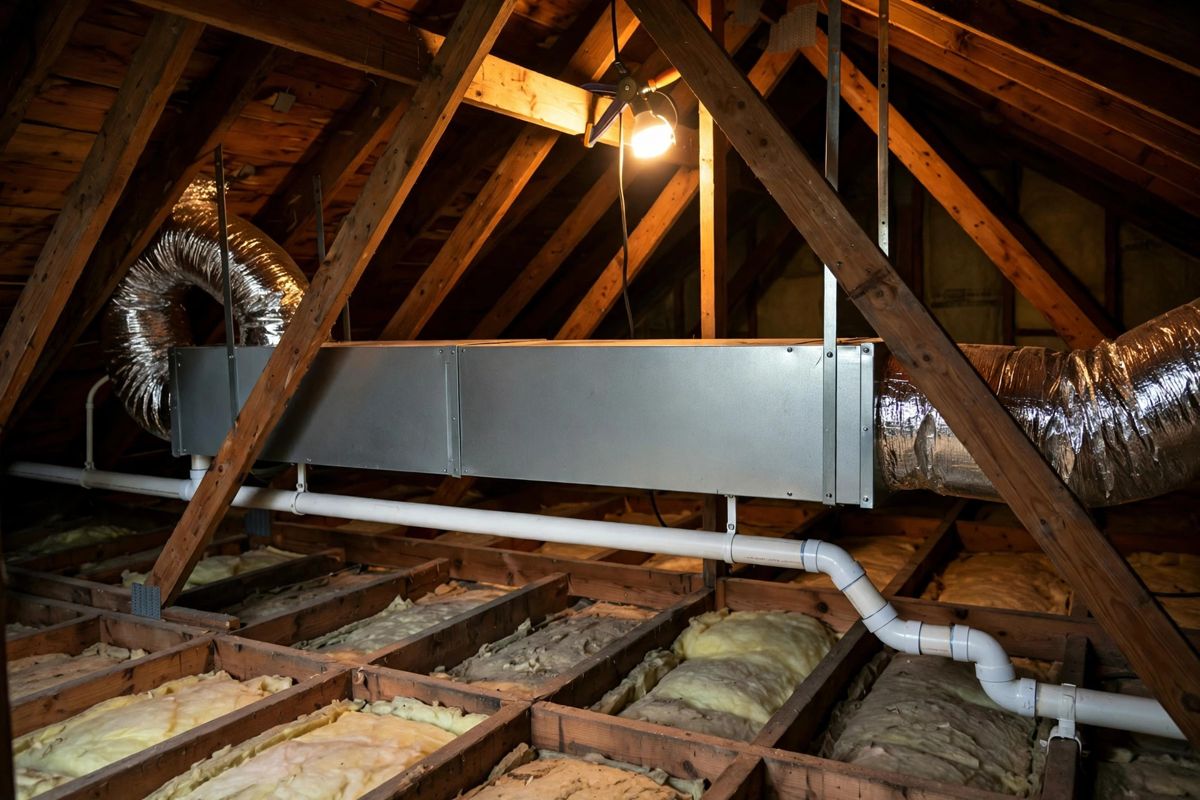
Third, find the condensate drain line, usually a white PVC pipe near the indoor unit, and look for its outside exit near the condenser. If the outside end is buried in mulch or mud, clear it gently. Never push anything deep into the line.
Fourth, check the filter and look for ice. A choked filter can freeze the coil, and a thawing coil dumps more water than the drain can carry. If you see ice, leave the system off and read the ice-on-the-system guide before restarting.
Is a little water under the unit ever normal?
Condensate belongs inside the drain pan and line, not on the floor. A few drops right after a repair can be residue, but recurring puddles always have a cause: a clog, a cracked pan, a tilted unit, or meltwater from ice.
Can I pour bleach or vinegar down the drain myself?
Many homeowners flush the accessible drain opening with a cup of vinegar, which can help with slime between visits. It does not clear a hard clog further down the line, or fix a cracked pan, so treat it as upkeep, not a repair.
The cause ladder, from drain slime to cracked pans
The bottom rung is the clogged condensate drain. Warm, wet drain lines grow algae and slime through a Texas summer, and builder-grade drain runs in homes built 2000 to 2019 often have shallow slopes where sludge settles. The pan fills, overflows, and the leak begins.
The middle rungs are mechanical: a rusted or cracked drain pan, a disconnected drain fitting, or a unit that has settled out of level so water runs over the pan lip instead of toward the drain hole.
The top rung is ice. Low airflow or low refrigerant freezes the indoor coil; when the ice melts, the surge overwhelms even a clear drain. If your leak follows weak cooling, the real fault may be charge, covered on the refrigerant leak page. A pro can also advise on a seasonal tune-up.
| Source | Clue it leaves | Typical fix |
|---|---|---|
| Clogged condensate drain | Pan full, water at the unit base | Drain cleared and flushed |
| Blocked outside drain exit | Drain backs up on humid days | Exit cleared, line flushed |
| Cracked or rusted drain pan | Steady drip in one spot under the pan | Pan replaced |
| Frozen coil melting | Leak after weak cooling or ice seen | Airflow or charge fault fixed first |
| Unit out of level | Water over one pan edge only | Unit re-levelled, drain checked |
| Disconnected drain fitting | Water right at a pipe joint | Fitting resealed or replaced |
What the pro does to find the real source
A careful visit starts dry-eyed: the pro inspects the pan, the drain line, and the coil before clearing anything, because clearing a clog first erases the evidence of why water overflowed. The float switch, if fitted, gets tested too.
The drain is then cleared with proper equipment and flushed, the pan is checked for cracks and rust, and the unit's level is confirmed. If ice is part of the story, airflow and charge are tested before the system is signed off.
You should hear which rung caused your leak, in plain terms, with a written range before paid work begins. BreezeCrew connects Cibolo homeowners with independent local AC professionals through the services hub.
What is a float switch, and should my system have one?
A float switch sits in the drain pan or line and shuts the system off when water rises, trading a cooling stop for a dry ceiling. Many newer Cibolo installs have one; older builder-grade systems often do not.
Will clearing the drain stop the leak for good?
If slime was the only cause, a proper clear and flush usually holds for the season. If the pan is cracked, the unit sits out of level, or ice keeps forming, the leak returns until that cause is fixed.
What leak repairs typically cost
A diagnostic visit to trace a leak commonly runs $75–$150 in this market, with some companies advertising lower dispatch fees that cover less testing. Simple drain clearing and pan-level fixes usually land inside the common $150–$650 repair band.
Costs climb with the cause, not the water. A replacement drain pan, a blower motor at $300–$700 when airflow caused the freeze, or a capacitor at $150–$400 behind weak airflow each price as their own job.
When ice is the root, refrigerant work enters: a recharge as part of a completed leak repair usually runs $200–$600. Coil work at $900–$2,500 is the rare top end. The local cost guide shows how these ranges fit together.
When a leak stops being a towel-and-wait job
Water through a ceiling is urgent in a different way from heat: every hour of delay widens the stain and the repair behind it. Switch the system off, protect what is below, and book the visit same day.
Treat it as an emergency if water reaches light fittings, electrical outlets, or a breaker panel, or if a ceiling bulges under pooled water. Keep people out from under a bulging ceiling and do not run the system again until it is checked.
A slow drip with the system off and the area protected can usually wait for a prompt routine visit. Either way, do not restart cooling just to test it.
Questions homeowners ask
Why is water pooling under my indoor unit?
The indoor coil pulls moisture from the air all summer, and that condensate should drain outside through a PVC line. Pooling means the water found another exit: a clogged drain, a cracked pan, a disconnected fitting, or meltwater from a frozen coil.
Can a clogged drain shut my whole AC down?
Yes, on systems fitted with a float switch. When water rises in the pan, the switch cuts the system off to prevent overflow, so the house warms up even though the equipment is healthy. Clearing the drain restores normal running.
How do I know if the leak is from ice melting?
Look for the pattern: cooling that weakened over days, visible frost on the copper line insulation, then water after the system rests. Ice melts in a surge and floods a drain that handles normal condensate fine. The ice cause has to be fixed, or the leak returns.
Is AC condensate water dangerous to my home?
The water itself is just condensed humidity, but where it lands does the damage: soaked drywall, swollen flooring, stained ceilings, and mould in damp cavities. Attic units are riskiest because leaks travel before they show.
How often should the drain line be cleared?
Once a year, ideally before the heavy season, suits most Cibolo homes. Through roughly 122 days at or above 90°F, condensate flows almost daily and slime builds steadily. A yearly clear during a tune-up, plus a vinegar flush mid-season, keeps most drain leaks from starting.
Related pages
Need a Cibolo AC pro?
Water where it should not be in your Cibolo home? Call (830) 555-0147 and BreezeCrew will match you with a local pro to trace the source.
Call (830) 555-0147